Jonah’s “Big Fish” Story 1: An Introduction to the Series

I have always enjoyed working through the book of Jonah with my Hebrew students. The book is a great introduction to Hebrew grammar, syntax, narrative, and poetry — and it is short enough to translate and discuss in a few weeks. But beyond the heuristic value of translating Jonah for beginning students of Hebrew, the little prophetic book also raises a number of big of interpretive and theological issues that make for great discussions. Jonah is a great example of literary artistry in the service of ideology, a great example of the importance of genre for interpretation, and great example of the significance of the history of interpretation, among other things. Who would have thought that a “big fish” story would have generated such interest! In a number of posts I hope to explore some of these issues.

Here’s the plan for this series: after I provide a post highlighting some resources for the study of Jonah, I will work through the book of Jonah in Hebrew with a series of posts leaving chapter two until the end (as my class is introductory Classical Hebrew, I want to leave the poetry for after the prose). Only after working through the book, will I post on some interpretive issues surrounding the book of Jonah.

So get your fishing rods… we’re about to catch a big fish!


One Year Blogiversary & 40,000th Visitor Contests

Things in my little universe are converging. The visitor count for my blog is approaching the magic 40,000 number. My one year blogiversary is also approaching on April 8, 2006. What is more, my own 40th birthday is fast approaching (I was born on the morning of April 1st, 1966 — and yes, I know that is April Fool’s day! And yes, I know how appropriate people who know me think that is! :-)).

At any rate, if I have done my math right, it may be possible to reach the 40,000 visitor mark on my actual 40th birthday! This will mean that my vistor count will also have to be a bit above average for the next three weeks. In order to meet this goal and to reward my 40,000th visitor, I have decided to have a couple contests.

Tell-A-Friend about Codex Contest

First, in order to raise my visitor count to ensure I hit 40,000 on or before my birthday, I am going to have a “Tell-A-Friend about Codex Contest.” The rules of the contest are simple:

  • Email a friend about Codex: Biblical Studies Blogspot — whether about the blog in general or about a particular post that you liked — and tell them to visit. The email should say something about my blog (“It’s the greatist thing since sliced bread”) and include the url to the blog (https://three-things.ca/blog). Here’s the catch: you need to CC me the email at “contest[at]biblical-studies[dot]ca.” The cc’d email will constitute your entry. (Remember to CC me or I won’t know you entered.)
  • Then after 12 noon on my 40th birthday (April 1, 2006, MST), I’ll pick an email completely at random from the cc’d emails sent to the above address and, presto, that individual will be the lucky winner. (Don’t worry, these emails will only be used to pick and contact a winner of this contest. I promise.)

So get those emails going! And remember to tell them to visit us here at Codex! Feel free to email as many friends/enemies as you want or have — multiple entries are more than welcome! (BTW: email lists will only count as one person!)

In addition, a post on your blog with a trackback or a link back to this entry or this blog will also constitute one entry. All you need to do is email me at at “contest[at]biblical-studies[dot]ca” and let me know about the post.

40,000th Visitor Contest

As I have done in the past with my 10,000th visitor (see here), whoever is my 40,000th visitor will also be a winner! There is not much you can do but visit here often and perhaps even read something! Once I have hit the 40,000 mark, I will blog the time and location of the lucky visitor and then they can contact me via email and verify with their IP address. To be fair, I will change my site meter icon once we get closer to the 40,000 mark so that no one just sits there refreshing the webpage!

The Prizes

The lucky winners will be able to select a free book from a number of possible options (that I will provide you) that relate to the focus of this blog (e.g., Biblical Studies, Hebrew Bible/Old Testament, Classical Hebrew, Faith & Film, Religion & Popular Culture, etc.).

Stay tuned for contest updates and good luck to everyone!


Fractures in Genesis: Karamat on Carr

Kevin Wilson over at Karamat has a good review of David Carr‘s book, Reading the Fractures of Genesis: Historical and Literary Approaches (Westminster John Knox Press, 1996; Buy from Amazon.ca or Buy from Amazon.com).

While it has been a few years since I read Carr, I can say that this is an excellent work on contemporary source criticism of the book of Genesis. Carr takes an approach that tries to balance traditional source criticism and synchronic approaches (or at least take them into consideration). At any rate, if you are interested in source criticism of the book of Genesis, take a look at Kevin’s review and then take a look at Carr for your self.


Hebrew Tattoos: Buyers Beware!

Believe it or not, one of the more frequent Google searches by which individuals happen upon my blog is a search for “Hebrew Tattoos.” This search, which appears to happen once every few hundred visits to my site, leads readers to my tongue-in-cheek post “Posh Hebrew Tattoos, David! (Beckhams Inscribe their Love).” I have also had individuals email me asking advice on Hebrew tattoos, primarily wanting verification about the spelling of this or that word. My own students also ask similar questions (the latest being just last week).

This interest in Hebrew tattoos intrigues me. It obviously piggy-backs on the popularity of tattoos in general, though I suspect that the fact you have high profile celebrities like David and Victoria Beckham, Madonna, and Britney Spears with Hebrew tattoos boosts their popularity. And, of course, you have the religious crowd that likes tattoos of a biblical character, whether Hebrew, Greek, or even Aramaic.

At any rate, after reproducing the Google search for “Hebrew Tattoos” you will come across a number of web sites that specialize in tattoos, even ones devoted to Hebrew Tattoos that want to cash in on the craze. Most of these sites have sample pictures of actual Hebrew tattoos. What I found troubling is the number of mistakes in these tattoos. As a public service to any individuals thinking of getting a Hebrew tattoo, I thought I would highlight some of the mistakes so that others may avoid them in the future.

Hebrew Tattoos You Don’t Want

hebrew_eloheem.jpg

This first example of the Hebrew term for “God” makes a simple mistake of confusing Hebrew characters that look similar (of which there are a few!). The bottom letter on the tattoo is a samech (a Hebrew “s”) while it is supposed to be a mem (a Hebrew “m”). Another possibility that Yitzhak Sapir noted in the comments, is that the final letter is the Rashi script for final mem. He suggests that “some Jewish figure who was uncomfortable writing out the name of God changed scripts as a result.” While this is certainly possible, it seems odd that the rest of the tattoo is standard Aramaic square script. I am also not sure how many Jewish tattoo artists are out there who know Rashi’s script! I think my explanation makes a bit more sense. This tattoo is an example of a simple mistake made by someone who was trying to match the letters from a picture or something (I get quite a few papers from students who know a little Hebrew and try to include Hebrew words but they confuse stuff like final mem and samech, resh and dalet, etc.). Either way, if you are going to get a tattoo, it’s probably better to use the same script for the entire thing!
holy_spirit_freedom.jpg

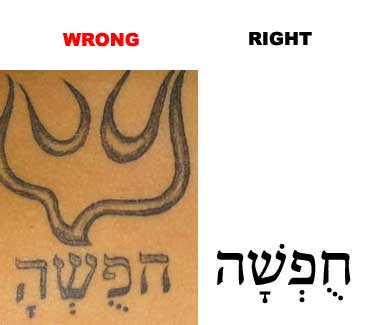
This tattoo, which has a Hebrew word purported by the website I found it on to mean “freedom” (perhaps based on Lev 19:20?) has the vowel points shifted incorrectly to the left. As such it is nonsensical. Moreover, as the comments to this post indicate, in modern Hebrew this word (if correctly pointed) means “vacation” — which I am pretty sure the individual who got the tattoo did not want (especially considering the symbol of the Holy Spirit above it!).

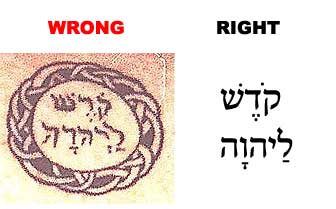
holy-to-the-Lord.jpg

This tattoo, which means “holy to the LORD/Yahweh,” has letters which are either not drawn very carefully or confused (note the difference in width in the second last character in the bottom word; the tattoo has what looks like a dalet or resh, which it should be a vav) as well as incorrect vowel pointing.

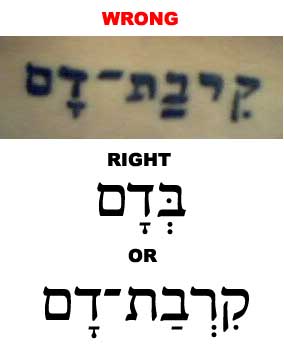
In_blood1.jpg

This tattoo is supposed to say “in blood” according to the website where I found it. The expression is not biblical Hebrew, but a modern Hebrew phrase for “blood relative” or the like (see the comments by Yitzhak Sapir). Of course, the tattoo is still incorrect since it is missing the silent sheva after the resh (and the resh looks a bit like a yod). (If I was going to write “in blood” in Biblical Hebrew, I would simply do it as I have it on the bottom.)

aramaic_yhwh.jpg

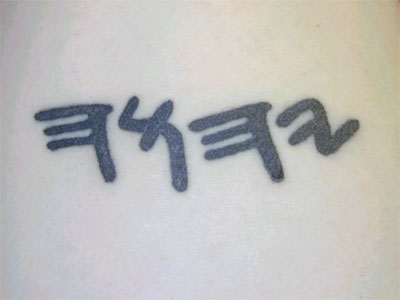
This tattoo of the name of the God of Israel, “Yahweh,” is fine, though the web page identified it as Aramaic. In fact, this is a paleo-Hebrew script of the divine name.

Hebrew_love.jpg

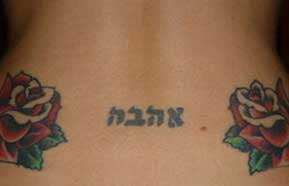
There is nothing wrong with this Hebrew tattoo. I just thought it’s funny because the word inscribed can possibly mean both “love” as well as “leather” (some scholars suggest that there is a homograph [×?הבה II] which means “leather” [see KB3]). It arguably occurs in Hosea 11:4 [perhaps] and Song 3:10 [more likely]). Perhaps this can be taken as a warning not to spend too much time in the tanning salons?! (Of course, in modern Hebrew ×?הבה clearly means love, and as I already noted, there is nothing wrong with this tattoo.)

The lesson here is that you cannot trust pictures of Hebrew tattoos on the internet! Make sure to double check the spelling of the Hebrew word you want tattooed!

Tips for Getting Hebrew Tattoos

If you are thinking of getting a Hebrew tattoo, consider the following:

First, think long and hard about getting a tattoo because they are permanent (notwithstanding modifying tattoos or erasing them). If you are set on the idea of getting a tattoo, think about getting a temporary one first. Also think about where you put your tattoo. Based on the experience of friends, I wouldn’t suggest getting a tattoo on any place where your body may change drastically as you age (and women, beware of tattoos on your stomach as if you ever get pregnant, your tattoo may be stretched beyond recognition (and it may not go back to its original shape — ask my friend!).

Second, if you are getting a Hebrew tattoo, make sure to double check with someone who knows Hebrew (or Greek if you are getting a Greek one) whether or not you have the proper spelling of the word. It would be a bummer to get a tattoo like those above — the only consolation would be that most people wouldn’t know you have a spelling mistake permanently inscribed on your body!

Third, one thing to decide before getting a Hebrew tattoo is whether or not to just use consonants (as Hebrew was originally written) or use consonants with the Masoretic vowel pointing (the little dots and dashes above and below the consonants). The vowel points were added to the text of the Hebrew Bible in the early centuries of this era by Jewish scribes called the Masoretes. While the vowel points represent an ancient reading tradition, they are not original to the Hebrew text, so you may not want to include them. (I personally wouldn’t include them if only for aesthetic reasons)

Finally, make sure to go to a reputable tattoo shop!

As a side note, I don’t have any tattoos nor any intention of getting one — and I hope that this trend will die down by the time my kids are older! My primary problem with tattoos is that they are too permanent; what you may think is cool when you are younger, you may later regret.
Movies Worth Watching (Oscars, Razzies, and Essential Films Follow-Up)

oscar_small.jpgTonight The Academy of Motion Picture Arts and Sciences will put on their yearly spectacle called the Oscars. I may watch the 78th Annual Academy Awards tonight, though I find the actual award ceremony to be way too long and way too boring — and I just can’t stand all of the glitz and glamour that surrounds the telecast. I really don’t care what so-and-so wears on the red carpet or what expensive gifts the already grossly over-paid and self-important celebrities received for the hard work of reading a prompter when presenting an award!

That being said, I like films and I consider myself an armchair movie buff. So I am interested in who the winners are; if only to see how misguided the Academy is! At any rate, if you are interested, a list of the nominees is available here. The only films that I hope win an award include A History of Violence (2005; IMDb) and Wallace & Gromit in The Curse of the Were-Rabbit (2005; IMDb); otherwise I don’t have any strong opinions.

razzieLogo.jpgMore significantly, the 26th Annual Golden Raspberry (Razzie) Awards were just announced. Legendary actors such as Rob Schneider, Jenny McCarthy, Hayden Christensen, and Paris Hilton all won well-deserved awards. The worst picture award (as well as three ohers) went to Dirty Love (2005; IMDb), which I didn’t manage to watch this last year — actually I hadn’t even heard of the film! (Don’t worry if you didn’t see it either; from the reviews it received it appears to have been very pathetic!). Perhaps the best category was the “Most Tiresome Tabloid Targets” in which Tom Cruise, Katie Holmes, Oprah Winfrey’s Couch, The Eiffel Tower, and “Tom’s Baby” were all honoured.

Now to some movies truly worth watching…

Essential Films Follow-Up

I have enjoyed the response to my two lists of “Essential Films for Theologians” (see my “Essential Films for Theologians: The ‘Director’s Cut’” and my “Essential Films of 2005 for Theologians – Extended Edition“). In the discussion of my lists (both on my blog and Ben Myer‘s Faith and Theology here and here), individuals have noted many excellent films that are definitely worth watching. In many cases these are films that I seriously considered adding to my own lists or are movies that I really should have considered but failed to remember them. In addition, David Williamson also came up with his own list of Top Ten Spiritual Films which is worthy of a gander.

In regards to my Essential Films for Theologians list, there were a number of other films highlighted in the comments that are definitely worthy of viewing. Most of them I had considered including on my list, while others I had not even heard of before and are now on my “films to view” list. Perhaps the only film which I feel I should have included for sentimental reasons is The Princess Bride (1987; IMDb).

Here are some other movies worth watching that were mentioned in the comments (in alphabetic order):

  • Andrey Rublyov (1969; IMDb)
  • The Best of Youth (La Meglio gioventù; 2003; IMDb)
  • The Butterfly (La Lengua de las Mariposas; 1999; IMDb)
  • Come and See (Idi i smotri; 1985; IMDb)
  • Diary of a Country Priest (Journal d’un curé de campagne; 1951; IMDb)
  • Fight Club (1999; IMDb)
  • The Game (1997; IMDb)
  • Itallian for Beginners (Italiensk for begyndere; 2000; IMDb)
  • Mean Streets (1973; IMDb)
  • Ordet (1955; IMDb)
  • Passion of Joan of Arc (La Passion de Jeanne d’Arc; 1928; IMDb)
  • The Pledge (2001; IMDb)
  • Pulp Fiction (1994; IMDb)
  • Pi (1998; IMDb)
  • Run Lola Run (Lola rennt; 1998; IMDb)

A couple films that I did not include in my “Essential Films of 2005 for Theologians” list or in the extended discussion, included Millions (2004; IMDb) and Stage Beauty (2004; IMDb).

All in all, there are many excellent films — as well as many not-so-excellent films — produced every year. The challenge, of course, is being astute enough to figure out which ones are worthy of our time! I only hope that I may have highlighted a few films that are worthy of viewing!