Posh Hebrew Tattoos, David! (Beckhams Inscribe their Love)

This was in the news yesterday (here, here, and here, among others), but I was too overcome with emotion to post it until today! Jewish soccer star David Beckham and his “posh” wife, Victoria Beckham, got matching Hebrew tattoos on their sixth wedding anniversary. The tattoo is apparently from the Song of Songs 2:16:

דודי לי ו×?× ×™ לו “My Beloved is mine and I am his”

There are actually web pages devoted to Beckhams’ tattoos!

I have mixed emotions about tattoos. I personally have no desire to get one and I sure hope this tattooing craze is spent by the time my kids grow up (OK, I guess they’re not so mixed!). The problem with tattoos is that they are just too permanent. I wouldn’t like to know what I would have tattooed on my body when I was 18! I’ve had students ask me (with increasing frequency) how to write this or that in Hebrew or Greek for a tattoo. I’ve been tempted to spell whatever they ask as נבל (fool!). Perhaps I should just quote Leviticus 19:28 and send them packing: “You shall not… tattoo any marks upon you: I am Yahweh” (I recall seeing this verse actually used as an argument against modern tattoos; I assume that the prohibition was due to some association with cultic practices of Israel’s neighbours rather than tattooing itself).

Sinaiticus to Enter the Digital World

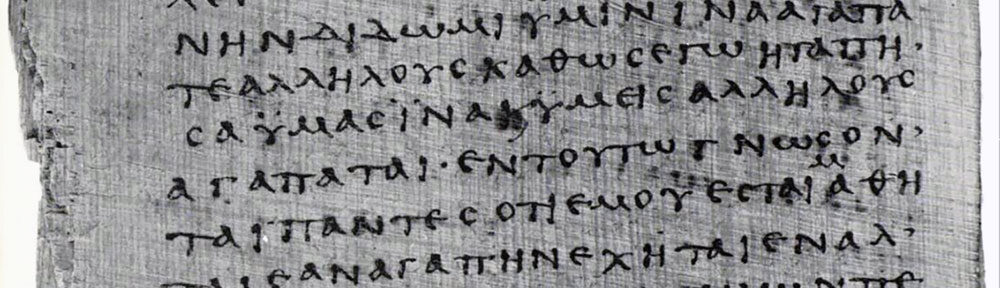
BBC News has an article on the digitizing of Codex Sinaiticus (the image to the right is the beginning of Matthew in the codex). This isn’t ground-breaking news (see below), though I have been watching for any stories on Sinaiticus since I am writing a dictionary entry on the codex for The New Interpreter’s Dictionary of the Bible.The BBC article has a number of errors. For instance, the tag line indicates that Sinaiticus is “the oldest known Biblical New Testament in the world” which it isn’t. Further down in the article they are correct when they say “it has the oldest complete copy of the New Testament.” Here’s another error: “It is named after the place it was written, the monastery of Saint Catherine in Sinai, Egypt.” More properly it should say that it was named after the place it was discovered. It may have been copied there, but it more likely was produced in Rome, Caesarea, or Alexandria.

I am surprised that BBC picked up the story when it did. Reuters published a similar story by Tim Perry early in July (it is still available here).


Hebrew Bible Related Reviews from RBL

As has become my custom of late, below are the Hebrew Bible (full, unedited, and even with a few bonus reviews from the “other” section!) entries from the latest Review of Biblical Literature, as well as some sundry comments by yours truly.

I was curious to see what Kraus said about The Book of Psalms: Composition and Reception, as I am reviewing it for another journal (Kraus evidently enjoyed the volume since he notes no shortcomings). If the recent recovery of the Leviticus scroll fragments has whet your appetite, then judging from Nitzan’s review, Secrets of the Cave of Letters sounds like an interesting read. There is also a very positive (albeit not very techincal) review of Logos Bible Software Scholar’s Library Silver Edition (for more on biblical studies software, go here). Finally, I would be remiss if I didn’t draw your attention to the review of Mowinckel’s He That Cometh by Jim West of the Biblical Theology Weblog. (Note the other review of Mowinckel’s classic is by Heinz-Josef Fabry, not Fabry Heinz-Josef as in the email and on the webpage).

  • Stephen L. Cook, The Social Roots of Biblical Yahwism. Reviewed by Kenton Sparks
  • John Eaton, Meditating on the Psalms. Reviewed by Philippus J. Botha and Brian Russell
  • Rodney J. Hutton, Fortress Introduction to the Prophets. Reviewed by Innocent Himbaza
  • Patrick D. Miller and Peter W. Flint, eds., The Book of Psalms: Composition and Reception. Reviewed by Thomas Kraus
  • Sigmund Mowinckel, He That Cometh: The Messiah Concept in the Old Testament and Later Judaism (Translated by G. W. Anderson). Reviewed by Heinz-Josef Fabry [N.B. Review in German] and James West
  • Jonathan A Draper, ed., Orality, Literacy, and Colonialism in Antiquity. Reviewed by James Loader [N.B. The review is in German]
  • Richard A. Freund, Secrets of the Cave of Letters: Rediscovering a Dead Sea Mystery. Reviewed by Bilha Nitzan
  • Scholar’s Library Silver Edition (Logos Bible Software) Reviewed by Jan Van Der Watt
Filed in:
Posted in RBL

UPDATE: Qumran Fragments on the Market?

Ed Cook at Ralph the Sacred River has posted a clarification of the quotes and information attributed to him in the story in Dutch newspaper het Parool. His response may be found here; my original blog entry is here. It appears clear that Ed was misrepresented by the story.

In regards to the Leviticus scroll fragments, Ed argues that the fragments ultimately have to be considered unprovenanced since they were not found in situ and no other related fragments were discovered in the alleged cave when Hanan Eshel was able to examine it. While I see his point (and I suspect we’ll never know for sure), I wonder what other Dead Sea Scrolls we would have to declare unprovenanced if held to the same standards?

A Course Dedicated to the Da Vinci Code?

The Ireland Sunday Times reports that Trinity College Dublin is offering a course on Dan Brown’s international best-seller, The Da Vinci Code.

I continue to be fascinated by the response this book has elicited. I thought it was a good read, but come on already! It has won awards and there are numerous books, documentaries, a forthcoming movie, and now even a course dedicated to debunking the claims made in the fictional novel! (I guess it doesn’t help that Dan Brown is on record saying that he believes the theories in his own book!) While I will be dealing with the book in my “Religion and Popular Culture” class this fall, I’m not sure it merits a full course!