Jesus Junk and Christian Kitsch 7.1 – Chocolate Deities

This won’t be a full edition of Jesus Junk and Christian Kitsch, but when I saw this sweet pantheon of Chocolate Deities, I just had to post it (for other editions of Jesus Junk and Christian Kitsch see here).

I thought about a number of different smart remarks when I first saw these: “I wonder if this is what George Harrison meant by ‘my sweet lord’?” or “Taking up your cross has never been so tasty.”

Here is the website’s descriptions of these divine delicacies:

Hand Made Gourmet Chocolates that celebrate the gods and goddesses of love and luxury, joy and happiness, compassion, peace and serenity, healing, and fertility of the body and imagination. We honor those deities who long for sweet offerings and embrace the notion that chocolate has powers to transport and inspire beyond mere consumables. All chocolates are made to order on the day you order them to ensure their freshness.

I especially liked these product endorsements: “These Chocolates are a godsend! They are artistic, meaningful AND delicious!” or “Many people worship the Buddha. Many people worship chocolate. Now you can do both at the same time.”

Here are a few of the delectable deities, starting with the Judeo-Christian tradition:

Not sure if these are Kosher, but my Jewish readers may enjoy muching on a Chocolate Star of David:

choco_stardavid_sm.jpg

For Christians, there are crosses and sacred hearts, but sadly, no crucifixes:
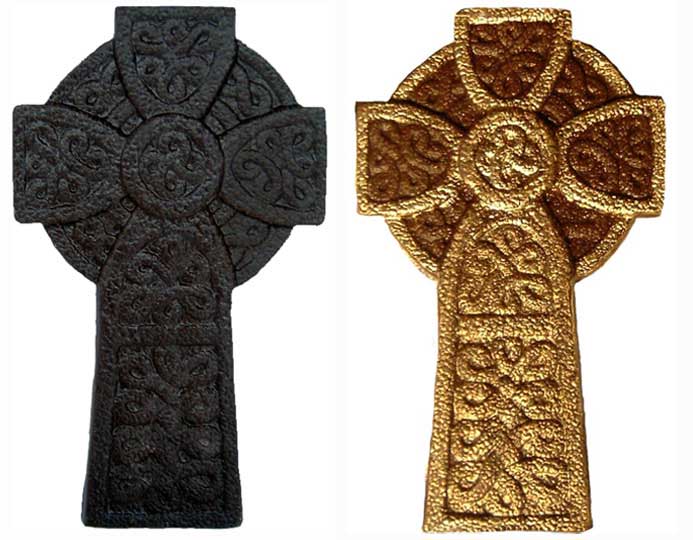
choco_cross_sm.jpg

choco_sacredheart_sm.jpg

Moving to the eastern religions, you find a whole panoply of pleasing gods, including Buddha, Krishna, and symbols like the Yin/Yang:


choco_buddha_sm.jpg

choco_krishna_sm.jpg

choco_yingyang_sm.jpg

There are many more Chocolate Deities available, including gods from native religion and other ancient gods and goddesses — take a look for yourself.

(HT Mary Ann Beavis)

SBL Forum: Ancient Texts, Google Books, and Wikis

The November edition of the SBL Forum is online. It includes articles on the biblical manuscript exhibition at the Smithsonian (as well as a review of the exhibition), an article exploring the benefits of Google Book, as well as number of articles on the value of Wikis for biblical studies (Noteworthy in this regard is Kevin Wilson’s notice on the Blue Cord Bible Dictionary). And instead of “Snakes on a Plane,” it offers “Bible Scholars on a Plane” (Gee, I wonder what is more terrifying!?). And there is even more, so make sure to check it out!

On a side note, does anyone know if previous forums are listed anywhere on the SBL site? It appears that once the new forum is posted, no index of the previous forums are available.


CSBS Ancient Historiography Seminar: Call for Papers

CSBSLogo.gif The Ancient Historiography Seminar / Groupe de Travail sur l’Historiographie Ancienne of the Canadian Society of Biblical Studies invites papers on self-identification, community identity, and ethnicity in Judahite/Yehudite historiography for the 2007 Annual Meeting at the University of Saskatchewan, Saskatoon (May 27-29).

Papers are invited to address a range of related questions, such as the understanding, presentation, and delimitation of “Israel” in various biblical texts, the relationship of Israelites to Judahites in Judean historical writings, the definition of Israel over against other peoples, the possible reasons why the ethno-religious community (“Israel”) was the focus of Judahite/Yehudite historiography, and the potential relationship of these issues to the Jewish-Samaritan controversy (at its earliest stages through the early part of the common era). Papers may approach the question from a variety of theoretical and disciplinary vantage points. For example, some may wish to pursue an inner-biblical perspective (Pentateuchal sources/writings, Former Prophets, Latter Prophets, Chronicles, Ezra, Nehemiah), while others may wish to pursue a cross-cultural comparative perspective (e.g., Ancient Near Eastern, Greek, Hellenistic and early Roman historiographies: Herodotus, Berossus, Manetho, Josephus; or be informed by non-Western historiographic traditions). Yet others may want to relate (or unrelate) the material remains to the question of community identity in northern Israel, monarchic Judah, and/or postmonarchic Yehud.

To be considered for our program, please submit a 250 word abstract to Ken Ristau (kar340 [at] psu [dot] edu) by December 1, 2006.

The Ancient Historiography Seminar / Groupe de Travail sur l’Historiographie Ancienne is a professional, academic working group of the Canadian Society of Biblical Studies / Société canadienne des Études bibliques (CSBS/SCÉB). For more information, please see our website.


Friedman on Humour in the Hebrew Bible

The Owings Mills Times has a small news report on a lecture Richard Friedman gave at a local synagogue. Here are some excerpts:

Friedman said it is difficult to get away from humor in the Jewish culture because it is part of the religion.

“It’s an integral part of our lives,” he said.

….

Jokes abound in the Torah, the five books of Genesis, Exodus, Leviticus, Numbers and Deuteronomy, Friedman said. The humor is especially obvious if the books are read in Hebrew. The Hebrew language lends itself to puns, he said.

The three pages of the Bible that are devoted to Jonah strike Friedman as the funniest. He said in Hebrew there are 35 puns in the story of Jonah.

The cast is composed of Jonah, who doesn’t want to do God’s bidding; a whale, who has to tote a poetry-writing prophet in his gut for three days and three nights, and a town full of repentants, people and cows who go around in sack cloth and ashes.

Jonah feels betrayed because he told the people they had 40 days to repent. God forgave them after only three days. After all, he did have his reputation as a prophet to consider, Friedman said.

Jonah leaves in a tiff, and goes to sit on a hill to sulk. In the end, Jonah learns a lesson about taking himself so seriously. The repentant people, not to mention the cows covered in ashes, are just as important as he is.

Friedman said jokes help people stay involved, whether they are attending a lecture or reading the Bible.

“Jokes are fun, they are a part of life, and they serve a purpose,” Friedman said. “They give comic relief when the lecture or book gets boring.”

I think that the humour in the Hebrew Bible is one of its most neglected features (see my previous post on this topic here).

Richard E. Friedman is the Davis Professor of Jewish Studies at the University of Georgia, and Katzen Professor of Jewish Civilization, Emeritus, at the University of California, San Diego. He has written a number of books, including Who Wrote the Bible? (HarperSanFrancisco, 1997; Buy from Amazon.ca | Buy from Amazon.com), The Hidden Face of God (HarperSanFrancisco, 1996; Buy from Amazon.ca | Buy from Amazon.com), and most recently The Bible with Sources Revealed (HarperSanFrancisco, 2005; Buy from Amazon.ca | Buy from Amazon.com). The latter is a translation of the first five books of the Bible — Genesis, Exodus, Leviticus, Numbers and Deuteronomy into English, differentiating textual sources by type styles and colors.