With the 2006 FIFA World Cup starting today, I figured I should post something related to football (i.e., soccer for those of us in North America). Then I thought, why not profile the Hebrew tattoo on England’s celebrity skipper, David Beckham? I have posted on David Beckham’s Hebrew tattoo before, though I didn’t have a picture of it until recently (An individual from Germany who wanted some advice on a Hebrew tattoo sent it to me). As with many of the tattoos profiled in my previous post on incorrect Hebrew tattoos, David Beckham’s tattoo just doesn’t make sense. Here is a picture of the tattoo:
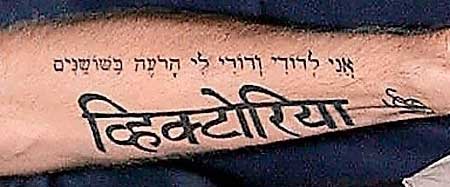
The words on the tattoo are taken from the Song of Songs 6:3 which reads as follows:
×?Ö²× Ö´×™ לְדֹּודִי וְדֹּודִי לִי הָרֹעֶה בַּש×?ֹּוש×?Ö·× Ö¼Ö´×™×?
“I am my beloved’s and my beloved is mine, he pastures his flock among the lilies” (Song 6:3)
While this is a very nice verse from the Song of Songs, it really isn’t appropriate for a man to have tattooed on his body! First, the word דֹּוד “beloved” in Biblical Hebrew is a term of endearment for a man, not a woman. It also can be used in the Bible to refer to your father’s brother (i.e., uncle), which is the primary meaning in modern Hebrew. It is not unisex like the English term “lover.” Second, the masculine reference is underscored with the last phrase of the tattoo: “he pastures his flock among the lilies.” The Qal participle “pasture” is masculine and clearly refers to a man. Some even argue that the image here is of a man kissing the tender part of his lover’s body. Thus, Beckham’s tattoo is totally inappropriate if he meant it to refer to his wife. And if he meant it to refer to his uncle, then it’s just sick! When it comes right down to it, this passage is really only appropriate for a woman to say to her male lover. It would have to be modified signifcantly to make it appropriate for a man to say to his female lover.
The moral of this story is, if you are a celebrity sports star with a lot of money and are thinking about getting a Hebrew tattoo, make sure you get it checked out by someone who knows what they are doing!
In fact, as a public service to all rich celebrities, I would be more than willing to advise them on their tattoos, or on anything related to the Hebrew Bible! That reminds me, do you want some more tutoring, Nicole?
 Monday evening (29 May 2006) there was a special joint lecture sponsored in part by the CSBS by Bart Ehrman entitled “The Alternative Vision of the Gospel of Judas.�
Monday evening (29 May 2006) there was a special joint lecture sponsored in part by the CSBS by Bart Ehrman entitled “The Alternative Vision of the Gospel of Judas.â€? Ehrman’s lecture focused on uncovering the significance of the “Gospel of Judas,” the recently uncovered second-century gnostic gospel that has been all the rage in recent months. In a nutshell, the significance of this gospel text, according to Ehrman, is not because it is somehow more authentic than the canonical gospels or because it somehow undermines the very foundations of Christianity. Rather, its real significance is because it is a serious document of real historical significance which gives us a glimpse into gnostic thinking in antiquity. According to Ehrman, the text’s closest ties are with various Sethian forms of Gnosticism, although it has clear alliances with other forms of early Christian thought (Valentinian, Thomasine, Marcionite). He even argued that there appears to be remnants of Jewish apocalyptic theology in the surviving text. He also noted how it has some unique characteristics compared to other gnostic texts, such as the sympathetic portrayal of Judas as the only disciple who really understood Jesus’ work and message (sounds like The Last Temptation of Christ). The lecture was well done, although considering his audience was mainly academics, he could have raised the level of the lecture a bit.
 I am quite excited about this new book on the Dead Sea Scrolls: