 I’ve added a few new commentaries in the Wisdom & Psalms section of my OT Commentary Survey.
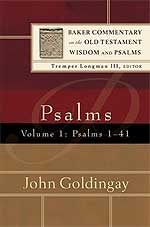
One commentary that I want to single out among the updates is John Goldingay’s superb volume on Psalms 1-41:
- . Psalms, Volume 1: Psalms 1-41 .
Baker Commentary on the Old Testament Wisdom and Psalms.
Baker Academic, 2006.
Buy from Amazon.ca | Buy from Amazon.com
I have always liked John Goldingay’s scholarship and this volume on the Psalter is no exception. Goldingay interacts with the best scholarship on the Psalms and presents it in a warm and engaging style that is both academically sound and theologically relevant. As such his commentary is ideal for pastors and Christian scholars and laypeople will also find it extremely accessible. I highly recommend it!
Another new commentary on the Psalms is in the popular Believers Church Bible Commentary:
- . Psalms.
Believers Church Bible Commentary. Herald, 2006.
Buy from Amazon.ca | Buy from Amazon.com
There is also a new commentary on Proverbs by biblical studies doyen Tremper Longman:
- . Proverbs.
Baker Commentary on the Old Testament Wisdom and Psalms. Baker Academic, 2006.
Buy from Amazon.ca | Buy from Amazon.com
Hot off the press is a new commentary on Ecclesiastes that looks at the reception history of the book:
- . Ecclesiastes Through the Centuries.
Blackwell Bible Commentaries. Blackwell, 2007.
Buy from Amazon.ca | Buy from Amazon.com
For more listings and evaluations of commentaries on other biblical books, see my Old Testament Commentary Survey.
 I am teaching an undergraduate course on the book of Genesis this semester, so I thought I would put together a post on what I consider some of the better commentaries on this foundational book of the Bible. I have focused on commentaries in English and have made recommendations for scholars, teachers and preachers, as well as students and lay people.
 From a more evangelical perspective, Gordon Wenham‘s masterful volumes are second to none. While Wenham is more concerned with literary and theological issues, he also engages most critical issues with scholarly responsibility. As such, Wenham is my choice for best overall commentary on Genesis.
 Other good critical commentaries include Coats (somewhat limited by the nature of the FOTL series) and von Rad (a classic tradition-history commentary albeit somewhat sparse), while Brodie‘s literary analysis is interesting to say the least. For a conservative Jewish perspective on the opening chapters of Genesis check out Cassuto. In addition, for those interested in the history of the interpretation of this book, the volumes in the Ancient Christian Commentary on Scripture by Louth and Sheridan are worthy of careful perusal. Finally, Hermann Gunkel‘s ground breaking commentary on Genesis has been recently translated into English by Mark Biddle and is full of many insights for the assiduous reader.
 For pastors and teachers, there are ample commentaries to choose from. Brueggemann, Cotter, Fretheim, Gangel, Hamilton, Mahthews, Ross, and Waltke are all good, though I would probably go with Hamilton if you are looking for one solid commentary written from an evangelical perspective. If you want a broader perspective, then both Brueggemann and Fretheim are excellent. While not a full commentary, Alter‘s translation is refreshing and his comments are also quite insightful.
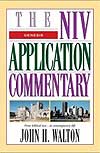 More popular-level commentaries include Gowan, Hartley, Janzen, Kidner, Roop and Walton. I have used Roop as a textbook in the past and have quite liked its style and theological substance. I also find the ITCs by Gowan and Janzen quite insightful. And Kidner, of course, always provides solid exposition from an evangelical point of view. I have to say, however, that I have been nothing but impressed with John Walton‘s commentary in the NIV Application Commentary Series. While he may be a bit more on the conservative side of the spectrum, his knowledge and engagement of the ancient Near Eastern literary, cultural, and historical background to the book are evident on every page. I highly recommend his commentary for pastors, students, and laypeople alike.