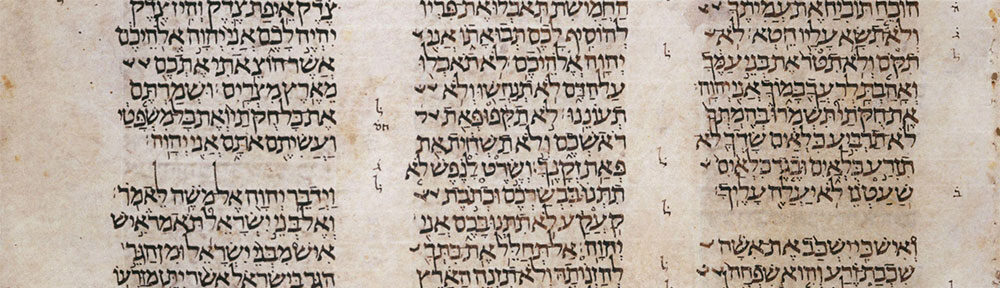
Forthcoming Hebrew Language Resources

There are a number of resources for learning Biblical Hebrew about to be published. Whlie I have not had the chance to look at any of these works, the first two books certainly fill a need for students of intermediate Hebrew — especially if they want to work on their own.
Chisholm-IntHebrew.jpgA Workbook for Intermediate Hebrew
Robert B. Chisholm
Kregel, August 2006.

Buy from Amazon.ca | Buy from Amazon.com

Designed to engage the Hebrew text and reinforce patterns and principles of Hebrew grammar and syntax, this resource expertly guides intermediate Hebrew students. Answers to all questions are provided, and both a useful parsing guide and glossary are also included.
Practioc-GradedReader.jpgGraded Reader of Biblical Hebrew: A Guide to Reading the Hebrew Bible
Miles V. Van Pelt, Gary D. Pratico
Zondervan, August 2006.

Buy from Amazon.ca | Buy from Amazon.com

Designed for the student who has completed a year of elementary Hebrew, or the pastor or scholar whose language skills have diminished due to lack of use. A structured introduction to the reading of biblical Hebrew texts. Through these readings, you will be able to review basic Hebrew grammar, become familiar with issues of intermediate grammar, and gain confidence in handling the Hebrew text. The readings chosen for inclusion, which are arranged generally in order of increasing difficulty, span the whole of the Old Testament and represent some of the most important Old Testament texts from the standpoint of biblical history, theology, and exegesis. The many notes that accompany the text include information on grammar, exegetically significant constructions, vocabulary words, idioms, bibliographic information, and more. Parsing exercises are included with each reading, and there is room to write your own English translation.
Fuller-Hebrew.jpgInvitation to Biblical Hebrew: A Beginning Grammar
Russell T. Fuller and Kyoungwon Choi
Kregel, August 2006.

Buy from Amazon.ca | Buy from Amazon.com

A tested approach to learning biblical Hebrew in an ideal package for the first-year Hebrew student. This clear, accurate, and pedagogically sound textbook emphasizes the basics: Hebrew phonology (sounds) and morphology (forms). This grammar does not use jargon or technical language, but uses terms easily understood and remembered so biblical Hebrew can be used with regularity and authority.

For more grammars and other language resources, see my Biblical Hebrew Resources page.

Thanks, Jim West!

Jim West held a contest of his own today, and guess what? I actually won something. I don’t win things very often, so I am pleased as punch! (OK, what does that mean, “pleased as punch”? How can a liquid be pleased?).

At any rate, I happened to be Jim’s 170,000th visitor at his site, and because of that I get a free book — to be more accurate, I get free “books.” Jim, who will now be known to me as “Jim the Generous” will be posting me the Encyclopedia of the Dead Sea Scrolls edited by Lawrence H. Schiffman and James C. VanderKam (Oxford, 2000; Buy from Amazon.ca | Buy from Amazon.com). With 450 articles by an international team of scholars, this two volume work offers the most comprehensive critical synthesis of current knowledge about the Dead Sea Scrolls — and their historical, archaeological, linguistic, and religious contexts. Written in non-technical language this reference work provides authoritative answers and information for all readers. This is a pretty expensive set — at least up here in the Canadian hinterlands. All I can say is, “Sweet!”

Thanks, Jim!


Go Up Baldy: The Curse of Baldness

Claude Mariottini, in a post on the “Old Testament and Baldness” linked to an article from the Mail & Guardian by Nicholas Lezard on The Horror of Going Bald. As one who at forty years still has a thick, lush, head of hair, such articles don’t concern me. The article did make reference, however, to one of my favourite(?) disturbing(!) Bible stories: the story in 2Kings 2:23-25 where Elisha calls a curse down on some children who are taunting his baldness. Here is the quote from the news article:

Baldness is a curse that demands all the fortitude at one’s disposal. It is a curse not only because it looks as though something biblical has happened to your head — it is also the way it is seen as comical, both as a fact, and as an occasion for comical reaction. The Moabites, reckless high-livers who made too many incursions into Israeli territory in the Old Testament, were afflicted, according to Jeremiah, by baldness. At one point Elisha is mocked by children (“There came forth little children out of the city, and mocked him, and said unto him, Go up, thou bald head; go up, thou bald headâ€?). Later God sends a couple of she-bears from the woods and they tear 42 of the Moabites to pieces.

What I thought was odd, was the reference to the mauled children as “Moabites.” Now, perhaps I am wrong, but the context is pretty clear that the children were from Bethel, an Israelite town. While Bethel may have shifted in political ownership between the tribe of Benjamin and Ephraim, it was never Moabite. Here is the biblical passage in question:


23 He [Elisha] went up from there to Bethel; and while he was going up on the way, some small boys came out of the city and jeered at him, saying, “Go away, baldhead! Go away, baldhead!� 24 When he turned around and saw them, he cursed them in the name of the LORD. Then two she-bears came out of the woods and mauled forty-two of the boys. (NRSV)

So the 42 “small boys” mauled by the bears were fellow Israelites. The biggest question surrounding this passage is “what do we make of it?” There are a number of disturbing passages in the Hebrew Bible. Many of them are horrifying illustrations of human depravity (e.g., Judges 19), which don’t necessarily reflect poorly on the deity of the Bible. But in this passage, it is God who is the implied agent behind the bears’ actions. Elisha curses the young boys “in the name of Yahweh” and then the bears go about their business.

The problematic nature of this passage has led to much exegetical gymnastics by commentators trying to make this passage less morally offensive. Many suppose the boys taunted Elisha at the instigation of their parents and that the who event was to be a prophetic warning to the inhabitants of Bethel. Others suggest the “young boys” were teenage ruffians, though the Hebrew makes this unlikely (while נער “lad” “boy” by itself may suggest adolecents, it is qualified by קטן “small,” which suggest they were on the younger end of things). Still others suggest that by taunting him to lit. “go up” they are wishing for his death (or at least his departure from this earth, perhaps similar to Elijah’s). Most of the explanations focus on the idea that when the boys taunted the prophet of Yahweh, it was tantamount to taunting God himself, and that their mauling is somehow justified. Obviously the adage, “sticks and stones may break my bones, but words can never hurt me” doesn’t apply to prophets! (This to me is the real problem with this passage, no matter how bad these boys were, their judgement sure seems to me to be out of proportion).

Any moral justification aside, God using animals to bring about his judgement is found elsewhere in Kings (1 Kgs 13:20–24 and 20:35–36). This is also akin to other extreme judgements in connection with the violation of the sacred (e.g., the touching of the Ark of the Covenant in 2Sam 6). Perhaps there is something in the many explanations offered about this passage. While this may be the case, I tend to think this is just one of those passages that reveal the dark side of the God of the Bible and it is better to let stand, rather than offer poor explanations to make it more morally palatable.

What do you think?

P.S. The South-Park-esque comic about this passage I mentioned in a previous post may be found here (be warned; the comic is twisted).


Revised Septuaginta Soon to be Published

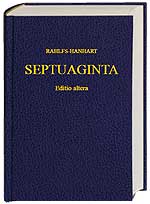
Wieland Willker on the Text Criticism list has alerted us to a revised edition of Rahlfs Septuagina to be published later this summer by the German Bible Society. The revision was done by Robert Hanhart and includes over a thousand minor corrrections and supplements to Rahlfs’ edition.

Rahlfs-Hanhart_LXX.jpgHere is the information from the German Bible Society:
Septuaginta (Das Alte Testament Griechisch)
Edited by Alfred Rahlfs
Editio altera (= 2., durchgesehene und verbesserte Auflage),
Edited by Robert Hanhart
12 x 18.4 cm
LXXIV + 2127 pages
ISBN 3438051192
€ 46.00

In an article published by Robert Hanhart last year (“Rechenschaftsbericht zur editio altera der Handausgabe der Septuaginta von Alfred Rahlfs” Vetus Testamentum 55 [2005] 450-60), it was made clear that this would only be a minor revision that will leave Rahlfs’ base text substantially intact.

This new “Rahlfs-Hanhart” edition will be out in July 2006.


David Beckham’s Manly Tattoo

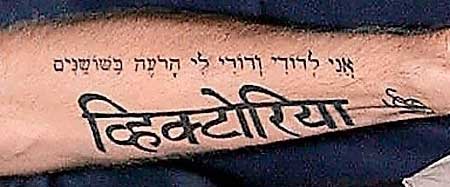
With the 2006 FIFA World Cup starting today, I figured I should post something related to football (i.e., soccer for those of us in North America). Then I thought, why not profile the Hebrew tattoo on England’s celebrity skipper, David Beckham? I have posted on David Beckham’s Hebrew tattoo before, though I didn’t have a picture of it until recently (An individual from Germany who wanted some advice on a Hebrew tattoo sent it to me). As with many of the tattoos profiled in my previous post on incorrect Hebrew tattoos, David Beckham’s tattoo just doesn’t make sense. Here is a picture of the tattoo:

beckham_tattoo_sm.jpg

The words on the tattoo are taken from the Song of Songs 6:3 which reads as follows:

×?Ö²× Ö´×™ לְדֹּודִי וְדֹּודִי לִי הָרֹעֶה בַּש×?ֹּוש×?Ö·× Ö¼Ö´×™×?
“I am my beloved’s and my beloved is mine, he pastures his flock among the lilies” (Song 6:3)

While this is a very nice verse from the Song of Songs, it really isn’t appropriate for a man to have tattooed on his body! First, the word דֹּוד “beloved” in Biblical Hebrew is a term of endearment for a man, not a woman. It also can be used in the Bible to refer to your father’s brother (i.e., uncle), which is the primary meaning in modern Hebrew. It is not unisex like the English term “lover.” Second, the masculine reference is underscored with the last phrase of the tattoo: “he pastures his flock among the lilies.” The Qal participle “pasture” is masculine and clearly refers to a man. Some even argue that the image here is of a man kissing the tender part of his lover’s body. Thus, Beckham’s tattoo is totally inappropriate if he meant it to refer to his wife. And if he meant it to refer to his uncle, then it’s just sick! When it comes right down to it, this passage is really only appropriate for a woman to say to her male lover. It would have to be modified signifcantly to make it appropriate for a man to say to his female lover.

The moral of this story is, if you are a celebrity sports star with a lot of money and are thinking about getting a Hebrew tattoo, make sure you get it checked out by someone who knows what they are doing!

In fact, as a public service to all rich celebrities, I would be more than willing to advise them on their tattoos, or on anything related to the Hebrew Bible! That reminds me, do you want some more tutoring, Nicole?