Reprint of Seeligmann’s LXX Isaiah Monograph

This week’s Review of Biblical Literature includes a review of Isac Seeligmann’s masterful The Septuagint Version of Isaiah. This reprint of his 1948 work includes an introduction by Septuagint scholar Robert Hahnhart as well as two additional essays by Seeligmann. Seeligmann’s work on LXX Isaiah is a great resource and having it reprinted (with corrections) will make it more accessible to scholars and teachers. The full bibliographic data is as follows:

Seeligmann, Isac Leo.
The Septuagint Version of Isaiah and Cognate Studies.
Edited by Robert Hahnhart and Hermann Spieckermann. Forschungen Zum Alten Testament 40. Mohr Siebeck, 2004.
Buy from Eisenbrauns.com

I highly recomend this work for all biblical scholars interested in the LXX version of Isaiah.

Some Pop Culture Thoughts: Is There Redemption for “Sin City”?

I went to see the film “Sin City” with a friend this week. The film moved at a brisk pace and was visually stunning. While I was expecting a film noir, it was a lot darker than I expected. The movie was loosely based on the graphic novels of Frank Miller, which are set in the fictional town of [Ba]sin City. There are a number of storylines in the film. [Spoiler Alert]

One storyline follows a really, really, bad guy named Marv (played impressively by Mickey Rourke) who trawls the darkest areas of town searching for the person who killed his “one true love,” Goldie. While perhaps his cause is noble (even though he only “knew” her for one evening!), his means of vengeance is anything but. The main storyline revolves around Bruce Willis’s character, Detective Hartigan. The film opens with Hartigan saving a young girl from a violent pedophile, who he injures in the process. While I don’t want to give away the movie, Hartigan is set up, but doesn’t say anything to protect the young girl and consequently goes to prison. Near the end of the movie the Hartigan character is released and ends up giving his own life to save the girl once again (now a young woman played by Jessica Alba). While much of the film is violence for the sake of violence, the idea of sacrificing oneself to save another obviously brings us images of Christ. I don’t know if I would go as far to say that Hartigan is a Christ figure in “Sin City” — especially since it is not even clear if he is successful. Moreover, the film totally buys into what Stone calls the “myth of redemptive violence,” which is in direct contrast to the way of Jesus. Not sure I would recommend the film; it is certainly not for the faint of heart. Also, Lord of the Ring fans beware: You will never look upon sweet little Frodo the same!

The Scrolls and the Hebrew Bible (Or: anticipating publication of 4QSama)

It is well-recognized that the Dead Sea Scrolls have revolutionized – and exceedingly complicated – our understanding of the text and history of the Hebrew Bible. Most of my research on the scrolls has focused on what has been perhaps one of the greatest catalysts for reviewing the development of the canon, namely, the so-called Qumran Psalms Scroll (11Q5 = 11QPsa). This psalms manuscript has a number of significant differences in content and order with the MT Psalter. The official editor of the scroll, James Sanders, and his heir apparent (and my personal friend), Peter Flint, have published extensively on this manuscript, laying out their “Qumran Psalms Hypothesis.” This view posits that the Qumran scrolls bear witness to a two-stage stabilization of the book of Psalms (Pss 1-89 and 90-150) and that 11QPsa contains the latter part of a “true Scriptural Psalter” or “edition” of the Psalter, among other things. While Flint and Sanders (and others) have argued their case extensively, I remain unconvinced on a number of points. That being said, this isn’t the scroll I wanted to talk about! If you want to know more about my own views on 11QPsa, you can take a look at my comments on this scroll on my Scrolls Introductions page. You can also stay tuned for some comments on a recent book devoted to 11QPsa by Ulrich Dahmen, Psalmen- und Psalter-Rezeption im Fruehjudentum: Rekonstrucktion, Textbestand, Sturktur und Pragmatik der Psalmen Rolle 11QPsa aus Qumran, which I will be reviewing for the Journal of Hebrew Scriptures).

What I wanted to comment on is a second scroll which has also had significant influence on our understanding of the development of the biblical text, namely, the Samuel scroll from cave four (4QSama), which is just being published in DJD 17 (those in the UK and Europe may already have a copy in your hands as its release date was April 7; in North America we have to wait until April 20 to get our hot little hands on it). My interest in this scroll is indirect. A number of scholars (e.g., Lemke, Ulrich, and McKenzie) have argued that 4QSama better represents the Vorlage of Chronicles than MT Samuel. Furthermore, it is argued that 4QSama reflects the same text-type as LXX Samuel. This means that places where Chronicles differs from MT Samuel, but agrees with 4QSama, that the Dead Sea Scroll may better represent his Vorlage. So rather than the Chronicler modifying his sources to fit his ideology (as virtually all commentators thought pre-Qumran), he was actually faithfully following his source text — but it was a text more akin to what is found in 4QSama or the LXX, rather than the MT. It will be nice to see the “official” edition of 4QSama, especially considering Herbert’s fairly recent monograph (A New Method for Reconstructing Biblical Scrolls, and its Application to the Reconstruction of 4QSam-a [Brill, 1997]) has identified 55% more deviations between the texts than previous publications. All this is to say that I looking forward to getting my hands on Qumran Cave 4.XII: 1-2 Samuel (DJD 17). Eight days and counting! (If you are as excited as I am, feel freel to buy it from Amazon.com!)
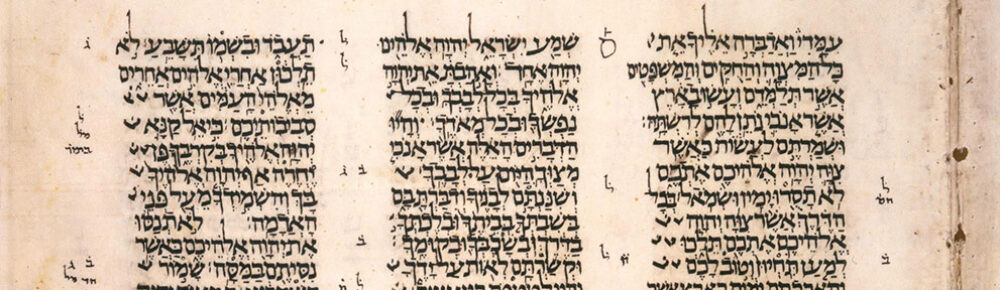
DSS Updates, including Abegg lecture online and some pictures.

I have uploaded an MP3 of Dr. Martin Abegg’s public lecture he gave at Taylor University College last week (April 4, 2005): "Jesus in the Dead Sea Scrolls? Messianic Expectations at Qumran." Dr. Martin Abegg is Co-Director of the Dead Sea Scrolls Institute, Graduate Program Director, and Professor of Religious Studies, Trinity Western University, British Columbia. The MP3 is available on my Taylor Public Lectures page.

I have created a Dead Sea Scrolls pictures page, where I have uploaded some scans of original photographs of the scrolls I received from the widow of R.K. Harrison. I believe they are the originals of the plates used in his out-of-print, The Dead Sea Scrolls: An Introduction (New York: Harper and Row, 1961).

Finally, I have also updated some of my Dead Sea Scrolls pages, including creating a Critical Editions of the Dead Sea Scrolls page were I list all of the DJD and Princeton volumes with full bibliographic information (thanks to Eibert Tigchelaar for some corrections and Ken Ristau for the Amazon links).